Saturday, November 21, 2009

Azeri President Threatens War Over Nagorno-Karabakh


The dictator cum president of the Caspian oil kingdom of Azerbaijan is threatening to retake a breakaway region by force. Ilham Aliyev was speaking a day ahead of another round of talks on Nagorno-Karabakh with his Armenian counterpart Serge Sarkisian. Nagorno-Karabakh is located inside of Azerbaijan but is populated mainly by ethnic Armenians who declared their independence from Baku in the early 1990s. A conflict left 30,000 deads and tens of thousands homeless. Talks on settling this conflict have been going on for years now. Ahead of Sunday's meeting in Munich, Aliyev boasted to ethnic Azeri refugees from the region that: "Azerbaijan is spending billions on buying new weapons, hardware, strengthening its position on the line of contact." Israel, of all countries, has been pouring weapons into Azerbaijan. That piece in Haaretz has this interesting point:

Foreign news outlets have reported that the two countries maintain intelligence and security contacts. The bolstering of these ties has reportedly been achieved by former Mossad agent Michael Ross.

Turkey is also playing a role here. They backed Muslim Azerbaijan in their conflict with Armenia and closed their border with Armenia in 1994 in a "sign of solidarity." Now Turkey and Armenia are set to kiss and make up, (despite huge differences over what the Armenians and most of the world calls the 'genocide' of over a million Armenians by the Ottoman Empire during WW I. The Turks say the dead were victims of the war and not a coordinated campaign). Anyway, Turkey won't ratify a treaty to reopen diplomatic ties with Armenia unless progress is made on Nagorno-Karabakh. Get it. Any way, the region is percolating with oil, as the ever stellar Secretary of State Hillary Clinton pointed out the obvious earlier this year when the Azeri foreign minister visited Foggy Bottom:

“Azerbaijan has a very strategic location that is one important not only to their country, but really, regionally and globally….”


As Rick Rozoff who does some of the best analysis of NATO in the former Soviet sphere puts it in this piece here:

The foundation of Western plans for Azerbaijan’s role in not only regional but ultimately global energy strategies began immediately after the breakup of the Soviet Union in 1991 and the creation of the Republic of Azerbaijan in the same year. After three and a half years of negotiations the so-called Contract of the Century was signed in the capital of Baku in 1994 with British Petroleum and other foreign oil companies including the American Amoco, Pennzoil, UNOCAL, McDermott and Delta Nimir firms.

The pivotal Baku-Tbilisi-Ceyhan oil pipeline project was agreed upon in 1998 and went into effect in 2006.


Imagine that, it's all about oil!

Wednesday, November 18, 2009

Lithuania Third Country To 'Host' CIA 'Torture' Camp?

Say what you will about the MSM and all their failings, but sometimes they get it right. In this case, ABC news has uncovered information that a hooty-tooty horseback riding school in Lithuania, of all places, was used by the CIA to 'interrogate' Al-Qaeda suspects. ABC says up to eight suspects could be interogated/tortured at one time at the facility outside the capital, Vilnius. It said the CIA constructed thick concrete pillars inside the site, which it bought using a front company. Earlier this month, Lithuanian lawmakers launched a probe into such claims and looked into whether any Lithuanian officials were complicit. The Informant covered earlier charges, and probes on secret torture sites in Romania and Poland. In both cases, there was lots of circumstantial evidence but no political will to go into it. More to come....

Reblog this post [with Zemanta]

Friday, November 13, 2009


PRAGUE - Down the street from our apartment in Prague is where the Czechoslovak “Velvet Revolution” got its spark twenty years ago.

Students had gathered on November 17 at Charles University to mark the killing of own of their own by the Nazis decades ago.

Events were not taking place in a vacuum, however. Tectonic shifts were underway across Eastern Europe. East Germans were fleeing in the thousands to the West. The Solidarity trade union under Lech Walesa was taking power in Poland. Hungary was dismantling its one-party rule system. The ultimate blow to the bankrupt system, however, was the crumbling of the Berlin Wall on November 9.

With revolution on their mind, Czech students marched to the center of town where they were met by a phalanx of grim-faced police in riot gear. It is common lore that the overthrow of Communism in Czechoslovakia went smoothly, peacefully, hence the “Velvet” tag. But that day, police were at their brutal best, attacking with batons protesters who approached them with flowers.

The crackdown was a catalyst. Angered by the police action and sensing the system was on its last leg, Czechs took to the streets in massive protests, jingling keys for change. Less than two weeks later, the Communist system was unraveling, and, Vaclav Havel, a playwright, political prisoner, and Lou Reed fan, would soon become the first president of a free Czechoslovakia.

Today, a small plaque commemorates the site where that fateful crackdown took place, but few take notice. Many are busy rushing in and out of a nearby supermarket. Capitalism is firmly entrenched here.

The cobble-stoned streets of Prague are lined with restaurants, pubs and upscale boutiques. With its architectural heritage given a needed scrubbing after decades of Communist neglect, Prague has become a top target of the camera-clicking crowd. The city’s roads are clogged with more and more upscale cars, pushing out the old boxy, Skodas, the Czech automaker.

Skoda, like most of the country’s industrial gems have either closed down or been snatched up by multinational conglomerates. Skoda is now part of the German giant Volkswagen, with all profits sent to Wolfsburg, its corporate headquarters.
Pisner Urquell, the Czech’s "King of Beers", from the city which gave the world a breakthrough in brewing and a beer type, Pilsen, is now just one brand of many of a South African-based beverage behemoth.

On the other hand, what has remained in Czech hands, has found navigating the free market waters tricky at best, treacherous, at worst. Czech glassware, renowned around the world, has taken it on the chin with most glass works either shutting down, or radically scaling back operations. In the town where my family has a summer retreat, the country’s oldest glass works, dating back to the 16th century, has closed its doors forever, not only throwing about 100 people out of work, but consigning to history’s scrap heap another part of the country’s industrial heritage.

But overall, Czechs are working, especially in the capital Prague, where go-getters equipped with better-than-average English face a favorable job market where unemployment is still just about 3% even with the current economic crisis. With a very good salary considered about $2,000 a month, it’s no wonder multinationals have flocked to Prague, Warsaw, and Budapest to cut costs.

Not all, however, have been embraced by capitalism. Homelessness is on the rise. Police have been ordered to push the unwashed, drug-addicted and unemployable out of the city center and out of the gaze of tourists, cherished for the needed coin they put in the city’s coffers.

That’s not the only relatively new ill Czechs are confronting.. “Night clubs” that hardly hide the prostitution going on inside, can be found on the back streets off the famed Wenceslaus Square, site of massive anti-Communist protests back in 1989. Those looking for cheap booze and sex have made Prague a top destination, leading one English paper to call Prague one of Europe’s sleaziest cities.

Outside the cities, change and prosperity has come, but at a much slower pace. As I mentioned the country’s oldest glassworks where our summer home is located near the border with Germany has shut its doors. A friend there had a scare years ago when the German owners of the thread factory where he works announced they might be moving operations further east to Romania, where wages are even cheaper. My friend makes about $700 a month.

The end of Communism has been good for the environment with some of the worst offending smokestack industries shutting down or upgrading to more environmentally-friendly equipment. Ironically, when we head to the country for fresh air, we get a lung’s full of coal grit. It’s like a time warp back to Pittsburgh when the city skyline was blanketed in grayness. With gas just too expensive for many, Czechs turn to burning coal, wood and whatever else is flammable -- even tires -- to keep warm in winter. Stocking up wood becomes a necessity bordering on obsession for some.

With all it warts, few here or elsewhere in the former East Bloc want to trash the free market and return to the past, despite the sense of security it did offer along with the cruelty and limitations.

I asked a friend who lives in Chribska, site of our rustic retreat, whether the current credit crunch had shaken his faith in the free market. Pepa had just had his hours cut back at the thread factory. He looked at me like I was kidding, before answering with a heaping dose of sarcasm, “Oh, sure we could go back to the way things were, when the shops were full, and we all drove Trabants,” the tiny clunker once churned out in bunches in East Germany.

The Trebants are gone as are the Soviet troops. The Czech Republic and other former Warsaw Pact nations are now members of what was the enemy, NATO. Membership in the now not-so-exclusive European club, the European Union, means the Czechs and other eastern Europeans are out of Moscow’s orbit, although the Kremlin is still reluctant to see it that way.

That partly explains why Moscow stomped its feet over U.S. anti-missile shield plans to deploy ten missiles in Poland and build a radar in the Czech Republic, ironically on the site of a former Soviet military site.

Vox populi in both Poland and the Czech Republic showed little support for the plan. However, the leadership in Warsaw and Prague believed it would further anchor them in the Atlantic alliance.

When U.S. President Barack Obama announced those two components would be scrapped in a rethink of missile defense, political leaders and thinkers here felt betrayed, and fear that Obama is caving to the Russian bear as Washington looks to “reset” relations with Moscow.

A former foreign minister, Jiri Dientsbier, told me such thinking is nothing more than scaremongering.

He has a point. Obama is not “abandoning” missile defend (whose genesis dates back to President Reagan and his “Star Wars” plan) but merely tweaking it. Mobile missiles are in and Poland may still get them, something Russia will not like, feeling already hemmed in by NATO which has swallowed up all of its former Warsaw Pact allies, and now sits on its borders in the Baltics and may some day encroach further in Ukraine and Georgia.

The Czechs have also been assured by Vice President Joe Biden that the Czechs could get in on the project too. He gave them that assurance on a recent trip to the Czech Republic, Poland and Romania. In the U.S. press, it was called a ‘mending-fences’ tour to reassure allies that Washington is not abandoning them in exchange for warmer ties with the Kremlin.

As noted, Washington has no plans to abandon missile defense, still pushes for NATO membership for Ukraine and Georgia, despite misgivings and opposition from many of their European allies, and the Pentagon is still at work to add to the over 1,000 military bases Chalmers Johnson says the U.S. military has around the globe.
Just before Biden arrived in Bucharest in October, the U.S. military announced it would be spending some $50 million to expand and modernize a military base in Romania. Neighboring Bulgaria will get $60 million of Pentagon money for a similar task there.

James Robbins, a senior fellow in national security affairs with the Washington-based American Foreign Policy Council think tank, said “the U.S. efforts in Romania and Bulgaria are part of a global redeployment strategy started in the early years of the Bush administration to shift U.S. forces out of Germany and move them eastward.”

That would put them closer to the Caspian Sea, whose abundance of oil and gas, has put the region in the cross hairs of Washington’s Machiavellian mandarins. Moscow, and increasingly China, are wary to say the least.

For some here, Eastern Europe has thrown off one master from the East and is being saddled with another from the West. At least this time, the shops are full.

Friday, October 05, 2007

Kosovo, The Coming Mess


The Informant is back, for now, after a hiatus of a few months or so. I will, of course, be focusing on news from Mitteleuropa, however, with a new focus on terrorism, organized crime, and all that is evil. Much attention will focus on Kosovo, which appears headed down the path to 'independence' because that is the fate the powers-that-be, (read Washington and Brussels) want pursued. The two sides, the Serbs and the Kosovo Albanians, have met face-to-face in September for talks. Why they met is anyone's guess. The U.S. has said once a Dec. 10 deadline for the talks to wrapup is here and nigh, Washington will recognize Kosovo's independence whatever the outcome of the current 'negotiations.' So, what motive exactly do the Kosovo Albanians have to negotiate, to compromise? None. All they have to do is run out the clock and they've got what they want. And what could come after could be ugly. Take this Reuters report It quotes a Croatian daily that says U.S. officials have asked the Croats to accomodate a wave of refugees, and make sure this human refuse doesn't soil the doors of EU territory. I embellish a bit, but that's what the Croat paper reports. Though Croatia doesn't border Kosovo, the eye-popping quality of the report is that U.S. adminstration guys know that should Kosovo declare independence, all hell will break loose.

Monday, March 19, 2007

Poland Wants To Do Away With Homosexual 'Propaganda' In Schools


As if things couldn't get weirder in Poland, they do. As the CEEI has been reporting off and on, the kooky goings-on in the People's Christian Republic of Poland have offered many a laugh. This one is truly bizarre. It seems the country's Education Ministry has introduced legislation that would outlaw "homosexual culture" from being taught in the classroom. What exactly homosexual culture is is never spelled out, but it seems to mean any information about AIDS and lessons telling kids to be tolerant of homosexuals. Deputy Education Minister Miroslaw Orzechowski, sounding ever so reasonable, said "there is no place for the promotion of homosexual culture" in Polish schools. Roman Giertych, his boss and leader of the right-wing League of Polish Families has offered the following wisdom" "one must limit homosexual propaganda so that children won't have an improper vew of family." Making things scarier is the fact this wacko party is a junior partner in the three-party coalition led by Prime Minister Jaroslaw Kaczynski's ultra-conservative Law and Justice party. As readers of the CEEI know, ol Jaroslaw and his brother Lech are top dogs in Poland, with Lech picking up the presidential duties. Both look alike and think alike, too. So it's not surprising that President Lech said the following on homosexuality: "If that kind of approach to sexual life were to be promoted on a grand scale, the human race would disappear." Human Rights Watch has chimed in with a condemnation on the proposed legislation, you can look at a press release here. HRW notes The proposed homophobic legislation follows a series of recent threats and abuses against lesbian and gay Poles by state officials. In June, the State Prosecutor’s office issued a letter to prosecutors in the municipalities of Legnica, Wroclaw, Walbryzch, Opole and Jelenia Gora ordering in sweeping terms investigations into the conduct of “homosexuals” on unspecified allegations of “pedophilia.”

Never boring in Poland

Saturday, February 24, 2007

Missile Defense Plan Continues To Heat Up


PRAGUE -- As if the Bush administration didn’t have its hands full already with the “war on terror” spiraling out of control in Iraq and even Afghanistan, and talk of Iran being the next target, U.S. plans to base parts of its anti-missile shield system in former Warsaw Pact nations Poland and the Czech Republic is threatening to rekindle the Cold War.


Under the proposal, the Czechs would house the radar system and the Poles the silos with 10 rockets to shoot down missiles fired from “rogue regimes” like Iran and North Korea. The United States already has missile interceptor sites in California and Alaska.

Russia, however, fears the system could be aimed at them.

Russian President Vladimir Putin says the proposal is further proof of the United States’ “increasing disregard for the fundamental principles of international law.” Putin has accused Washington of trying to reignite the global arms race.

General Yuri Baluyevsky, Russian army chief of staff, speculated publicly about whether to withdraw from the 1987 Intermediate-Range Nuclear Forces treaty, which had led to the disarmament of medium-range missiles. General Nikolai Solovtsov, commander of Russia’s missiles forces, has said Russian missiles could be aimed at the Czech Republic and Poland if they agree with the U.S. plan.

Russia is also planning to spend $189 billion to beef up its military. Defense Minister Sergei Ivanov has announced plans for drastic increases in the number of ballistic missiles, nuclear submarines and aircraft carriers. The Russians also plan to quadruple the number of Topol-M missiles.

In the West, the saber-rattling talk from Putin and his military illustrates that it is Putin’s Russia that is looking for conflict. Putin is viewed as a growing autocrat bent on using all means possible, namely oil and natural gas, to regain influence in the former Soviet empire and Western Europe.

However, the U.S. decision to base parts of its anti-missile system is another sign of waning Russian influence in its former empire and how Washington is creeping closer. NATO has gobbled up much of Eastern Europe and even the former Baltic Soviet republics of Latvia, Lithuania and Estonia, putting this U.S.-dominated military club right on Russia’s border. Ukraine and Georgia could join NATO in the future. U.S. military forces are in other former Soviet republics, including, Kyrgyzstan, Uzbekistan, and Azerbaijan. Russia finds itself increasingly encircled, hence the paranoid over the anti-missile shield.

Russia wants Washington to promise in writing that the missile system is not aimed at its country, according to a Feb. 6 Interfax report.

“The Russians say, ‘This is my backyard. You need our cooperation.’ They are right. You cannot stop Iran or contain Iran without Russia. You need the Russians on board,” Andrew Brookes, a space technology expert at London’s International Institute for Strategic Studies, told the AFP news agency on Jan. 26.

Russian objections may be the strongest, but they are not the only ones.

German Foreign Minister Frank-Walter Steinmeier and Defense Minister Franz Josef Jung have criticized the US for failing to discuss the plans with Moscow. Iran didn't possess any intercontinental rockets that could reach the United States, Steinmeier added.

Opposition to the project is strong in both Poland and the Czech Republic. But it appears the governments in Warsaw and Prague aren’t listening. Prime Minister Mirek Topolanek and his Polish counterpart Jaroslaw Kaczynski have said they back the proposal. Ironically, the hostile reaction from Moscow has probably tipped more pols and the public into the pro-camp.

The leader of the Czech opposition Social Democrats, Jiri Paroubek has backed off from calls for a referendum after “being leaned on,” by U.S. officials in Prague, according to the London Guardian.

Lost in the whole debate is whether, militarily at least, there is any point to building a radar station in the Czech Republic. According to Bruno Gruselle, a researcher at the Paris-based Strategic Research Foundation, “the U.S. military already has radar stations in Norway, in Greenland, and in Britain—on top of its Defense Support System satellite alert system—which permit the early detection of missiles, wherever they come from.”

Perhaps the U.S. goal is more political than military. In his 1997 book, The Grand Chessboard, former U.S. National Security Advisor Zbigniew Brzezinski wrote that maintaining U.S. primacy would require Washington “to prevent collusion and maintain security dependence among the vassals, to keep tributaries pliant and protected, and to prevent the barbarians from coming together.”

None of the vassals here in “New Europe” are making any mention of that.

Saturday, February 17, 2007

Polish Parliamentarian Publishes Controversial Pamphlet


A pamphlet has whipped up a firestorm of protest among Jews in Europe. Maciej Giertych, a Polish member of the European Parliament, earlier this week published his short tract, "Civilizations at War in Europe", in which he sets out some pretty controversial thoughts. According to dpa, the pamphlet contains such doozies like Jews form a "civilization of programmed separateness, of programmed differentiation from the surrounding communities (and) prefer to live a separate life, in apartheid from surrounding communities." Also that Jews "tend to migrate from poorer to richer lands." The European Jewish Congress is upset, to put it mildly. It says the book-pamphlet (not sure which) reeks of medieval hate and 19th Century racial stereotyping. They want Giertych stripped of his parliamentarian immunity and they say they could take the guy to court. Making matters worse, the European parliament actually put up coin to publish Giertych's dubious tract. According to the French daily Liberation, the European parliament has no intention to move against Giertych. German lawmaker Hans-Gert Poettering told Liberation, "There is no censorship a priori of publications published by European deputies. It is contrary to European values." The 71-year-old Giertych holds some pretty hard-right views, including opposing homosexuality, and moral relativism. He's a literalist when it comes to the Bible. Believes the "creationist" tale and once calculated the size of Noah's Ark. If interested in more of this guy's bio, check out his bio on Wikipedia.

Poles Plan To Pave Over One Of Europe's Only Wetlands

The Rospuda Valley is one of Europe's most unique wetlands. According to Greenpeace, the wetland in northeast Poland is home to a wide array of flora and fauna, many of them extremely rare, even on the verge of extinction! Sounds like the perfect place to run a road through, right folks? Sadly, the Polish government thinks so, and is going ahead with plans to build a 17-kilometer stretch of an elevated highway through the Rospuda wetland to the popular Mazurian lakes resort town of Augustow. Doubly sadly, the country's evironmental minister Jan Szyszko has signed off on the project. The highway is a piece in a bigger asphalt puzzle. The idea is to build a highway linking Poland with its fellow EU friends up in the Baltic, Lithuania, Latvia and Estonia. Not everyone is smitten with the project, and not just granola-crunching tree-huggers. Poland's Ombudsman and the bigger honchos in Brussels, the European Commission, think the project doesn't meet strict EU environmental rules. According to German news agency dpa, the European Court of Justice could hand down fines if they find the project violates EU legislation. Greenpeace is taking action as well, more direct. They've set up a camp in Rospuda to block construction.

Wednesday, February 14, 2007

The European Parliament CIA Saga

Well CEEI readers, yours truly has been chronicling off and on this European parliamentary probe into CIA rendition flights and other skullduggery on European soil. Well, on Valentine's Day, they issued their final report. More precisely, the report was voted on by over a thousand lame lawmakers. Yes, that number is right. Here's how the vote broke down: 382 backed the report, 256 voted against, and 745 abstained. Wow, the European parliament is big. Anyway, the final report more or less repeated some of the stuff I've already reported. At least 1,245 CIA flights alleged in and out of Europe since 9/11. The lawmakers picked on several countries including Spain, Romania and Poland. It also said the Italian government had to know of the extraordinary rendition of Abu Omar within its territory. An Italian prosecutor wants to try 26 Americans, all but one CIA spooks, and six Italians over the 2003 kidnapping of the Muslim cleric Abu Omar in Milian. The vote broke down the left-right political spectrum. Socialist Claudio Fava, who authored the report, said, "It is the rigorous analysis of five years of excesses and abuses often tolerated in the name of the fight against terrorism." On the other side of the aisle, rightwingers accused the accusers of 'anti-Americanism." Jas Gawronski, a leading conservative, said the report, "presumes there is one chief guilty party and that is the United States. That's why we don't like this report." Think this will be anything more than another report to be tossed in the pile and forgotten, think again. EU Justice and Security Commissioner Franco Frattini said: "It is not for the European institutions to pass judgement and to hand out verdicts but... to ask that the truth be sought." He was refurther to further probes at the national level now ongoing in several states including Germany, Spain and Portugal. On Wednesday, Switzerland started criminal proceedings against those responsible for the abduction of Abu Omar in Italy and allegedly flown thru Swiss airspace. According to the Swiss Federal Office of Civil Aviation, U.S.-registered planes suspected of being used by the CIA crossed Swiss airspace at least 74 times since 2001.

Saturday, February 10, 2007

Bulgaria and Romania To Be Launch Pad For US Attack On Iran?


Will the U.S. launch its much-feared assault on Iran from Romania and Bulgaria? Both countries are part of what Donny Rumsfeld called the "New Europe" that is not wise to the deceit and lies of Washington like "Old Europe", and has an almost starry-eyed admiration for all American, at least as far as these countries elites go, and, after all, as Mr. Bush put it, they are the 'deciders.' Well, an obscure Bulgarian news agency, Novinite, put out an item at the end of January saying the U.S. "could be using its two air force bases in Bulgaria and one at Romania's Black Sea coast to launch an attack on Iran in April." The report was picked up by Scotland's Sunday Herald and that got picked up by other papers including this report by the Turkish Daily News. As the Sunday Herald report notes Bulgaria is "setting up new refueling places for US Stealth bombers, which would spearhead an attack on Iran." Bulgaria okayed 3 bases for U.S. troops in April, 2006. As an American official told the Washington Times having bases in the Balkans would put the American nearer to the 'action'. "One of the key issues anywhere is our ability to use our soldiers where we need them." "Otherwise, we would be tying ourselves [down]. The old model [during the Cold War] was that we had forces in Europe because we thought we'd fight in Europe." It was also a sweet deal for the Yanks: Officials of both countries said the United States will not pay rent for its use of the Bezmer and Graf Ignatievo air bases and the Novo Selo army training range and storage facility. But, according to the agreement, it will cover "operational and maintenance expenses." As to whether the Romanians are in on the Iran attack plot, China's "People's Daily reported the Romanian Defense Ministry has kept its mouth shut, but the Chinese note interestingly that Defense Minister Sorin Frunzaverde is paying a working visit to the United States on Jan. 30 - Feb. 3. For those who believe this is all bluff and fear mongering, think again. As this Guardian article notes, plans to bomb Iran are well advanced at the Pentagon. Stay tuned...

Wednesday, January 31, 2007

Russians Up The Ante In Missile Shield Mess


Think the Russians aren't pissed by U.S. plans to put a radar station in the Czech Republic and missiles in Poland as part of the tested-but-definitely-not-true anti-missile system? Think again. The Russian bear is beginning to roar, warming the cockles of folks who yearn for the days of the Cold War. On February 8, Russian Defense Minister Sergei Ivanov announced plans for drastic increases in the number of ballistic missiles, nuclear submarines and aircraft carriers. The Russian's also plan to quadruple the number of Topol-M missiles. It's all part of a what the Guardian calls a $189 billion 'revamp' of Russia's rusty, and rotting military. The Guardian report partially pegs the Russian military increase to anxiety over Washington's missile defense plans. This weekend, Ivanov is at a big defense-type pow wow in Munich where he's expected to chat with U.S. Defense Secretary Robert Gates. Ivanov has restated some of Russia's arguments against the 'shield.' A glance at the map shows that Poland and the Czech Republic are in the wrong place to protect the United States from North Korean attack, while a launch from Iran could be brought down in neighboring states, Ivanov said. "It is common knowledge that any missile that is following a ballistic trajectory can be intercepted at the initial booster stage. If it is so... why can't our U.S. partners deploy the system in Iraq, Afghanistan or Turkey?" Ivanov said, according to the AP news agency. Asked if he understood Ivanov's concerns, Gates said "Not really." That's a real quote, folks.

Germany Going After CIA Spooks


The short arm of German law is coming for the CIA. They want to arrest 13 suspected (always suspected, not like CIA agents roam about handing out business cards blowing their cover) CIA agents for their role in the 2003 abduction of a German national. Khaled al-Masri, a German citizen of Lebanese descent, says he was abducted in December 2003 in Macedonia and flown by the CIA to a detention center in Afghanistan, where he was allegedly abused. Al-Masri says he was released in Albania in May 2004 after the CIA discovered they had the wrong man. Oops! The 13 suspects were crew and passengers on an aircraft which flew el-Masri from Macedonia to Afghanistan. My friends at Deutsche Welle have this interesting bit: Public broadcaster NDR had reported earlier that most of the CIA employees sought lived in North Carolina in the United States. NDR said Spanish authorities had learned the identities of all 13 agents on board and had copies of some of their passports. Although all of the names were believed to be aliases, NDR said it was possible, using other data, to learn their real identities. The report said three of the suspects worked for Aero Contractors, believed to be the CIA's secret airline.German arrest warrants are not valid in the United States but if the suspects were to travel to the European Union they could be arrested. Maybe during Oktoberfest? Germany, as you CEEI readers know, Hamburg, to be precise, was a hangout for the 9/11 terrorists. As the German muckracking mag, Der Spiegel, reported in 2005, it was a key 9/11 suspected who fingered al-Masri. Here's a good bit from that article: One of the key figures in the deadly Sept. 11 attacks, the Hamburg-based Yemenite Ramzi Binalshibh, told the CIA of a coincidental meeting he had once had on a train ride. He was told of a man by the name of "Khalid al-Masri" who had apparently urged Mohammed Atta's Sept. 11 pilot crew to get training in Osama bin Laden's camps in Afghanistan. Binalshibh was also told that this man "al-Masri" had helped Atta's men establish contact with a senior al-Qaida member in the city of Duisburg in western Germany's Ruhr region. Not satisfied with the CIA's mea culpa it goofed, ( and who would be?) Al-Masri has filed a landmark suit, with the help of the ACLU, against the U.S. The suit, as the BBC, nicely sums up here, claims that former CIA director George Tenet and other CIA officials violated US and universal human rights laws when they authorised agents to kidnap Mr Masri. The lawsuit says Mr Masri suffered "prolonged arbitrary detention, torture and other cruel, inhuman, or degrading treatment".

Friday, January 26, 2007

Czech Town Set To Rebury Nazi Remains


You'd think few if any in the Czech Republic would want to memorialize anything to do with the Nazi regime. After rolling into the country in 1938, Nazi soldiers killed, maimed, and deported thousands as well as razed villages before the nightmare ended (at least for a brief time before the Communists unleashed their own brand of terror) in 1945.

Not so. Tucked away in the northeast of the country, not far from Poland, where coal and heavy industry is king lies the town of Hlučin. The town is testament to a time when a mishmash of nationalities lived in Czechoslovakia. Many in Hlucin were Germans. And during World War II, several hundred served not as partisans with their fellow countrymen the Czechs, but with the invading Wehrmacht.

Today, many in this town of 14,000 are proud of their German heritage. In fact, hundreds hold German passports. Now, some think its time to honor their forebears who picked up a gun to fight for Adolf Hitler's Germany. They want to rebury the remains of 3,900 Wehrmacht soldiers in the town cemetery.

"It won't offend anyone. Afterall, lots of Hluciners fought in German uniforms," explains Mojmir Sonnek, the leading organizer to rebury the fallen Nazi soldiers.

Wednesday, January 24, 2007

European Parliament Names Names In CIA Rendition Probe


European lawmakers have named the names of those countries who knew the CIA was soiling on their soil and either looked the other way or held out a helping hand. Who's on the list? Britain, Poland Germany and Italy are among the 10 naughty nations listed in the report drafted by Italian Socialist Giovanni Fava. What's in the report? Not much in the way of hard facts. That doesn't mean there's no meat. Secret documents, confidential sources, including records of meetings between EU, NATO and senior U.S. State Department officials are in there. Plus, there are dozens of hours of testimony by those who said they were kidnapped by U.S. agents on European soil and transferred to secret prisons. Perhaps most eye-raising is what they got from Eurocontrol, the EU's air safety agency, according to which more than 1,200 undeclared CIA flights entered European airspace since 9/11. The EU lawguys "condemned the fact that European countries have been relinquishing their control over their airspace and airports by turning a blind eye or admitting flights operated by the CIA which, on some occasions, were being used for extraordinary renditions." The Europeans admitted they couldn't dig up enough evidence on Poland's alleged CIA torture center. The report also points the finger at the Germans for failing to accept a U.S. offer, made in 2002 to release Murat Kurnaz, a Turkish citizen resident in Germany, from the U.S. prison camp at Guantanamo Bay. Kurnaz was picked up in Pakistan in 2001 turned over to U.S. authorities and held at Guantanamo as a terror suspect. He was released in 2006 after a federal judge deemed the evidence against him was too weak to hold him. The European parliament report was followed by another report, this one by Human Rights Watch which accused European countries of undermining an international ban on torture by accepting "empty promises of humane treatment" in justifying turning over terror suspects to countries where they risk being tortured. Human Rights Watch singled out Britain and Sweden, (yes, you read that right) as the worst transgressors in this respect. The land that gave us Abba handed over to the CIA two Egyptian terrorism suspects after the U.S. spooks gave their word -- who would think the CIA would lie? -- the two would not be tortured. And they weren't ............................. not, as Borat would say.

Monday, January 22, 2007

Poles And Czechs Mull U.S. Anti-Missile Shield


American plans to build part of their controversial anti- missile defense system in the Czech Republic has sparked debate in the central European country and mobilized progressive forces who oppose it. Several hundred turned up on a chilly, snowy day in late January on Wenceslas Square in the Czech capital, Prague, just part of a multi- pronged campaign against the plan. Hinting at the Soviet crackdown on the “Prague Spring” reform movement of 1968, demonstrators held up placards reading: “1968 – Go Home, Ivan! 2007 – Go home, John!” Pavel, a Prague university student said he was tired of his government “kissing someone’s ass.” The Bush administration announced on January 20 that Washington had asked the Czech Republic and Poland to base parts of the system. Under the proposal, the Czechs would house the radar system and the Poles the silos with 10 rockets to shoot down missiles fire from “rogue regimes” like Iran and North Korea. The U.S. already has missile interceptor sites in California and Alaska. A missile site in Poland would be the first outside the U.S. and the only one in Europe. Public reaction to the proposal in both countries has been lukewarm at best, while Moscow has criticized it with rhetoric reminiscent of the Cold War. Critics see it as the latest American move to expand its military grip around the globe. “The government does not have a mandate to authorize the base,” Jan Tamas, the main organizer of the “No Base” movement, which is calling for the government to at least let the people vote on the proposal. Prime Minister Mirek Topolanek has balked at the idea of holding a referendum, arguing, “security issues usually are not decided by referendum.” “Locating the base here will undoubtedly improve the security of the Czech Republic and Czech citizens,” Topolanek said. But many Czechs fear the base will make them a target of a terrorist attack as they are dragged into Washington’s geopolitical schemes. Nevertheless, several vox populi show a majority of Czechs actually back the plan, perhaps hoping the U.S. will at least drop visa requirements for them. Also lingering fears of Russia, may tip the Poles and Czechs into the arms, literally, of the Americans. Backers also see it as a chance for the Czech Republic to do its part in the global “war on terror,” among them the former dissident, playwright and president, Vaclav Havel, who has backed many an American intervention, including the Iraqi war. “Do the Czechs want to be a modern European society, which feels a shared responsibility for the state of the world, or would we prefer to leave the resolution of global problems to others,” Havel asked. Topolanek will face a tough task winning parliamentary backing for the American plan. His fragile center-right government was cobbled together after seven months of on-again, off-again talks. Topolanek’s Civic Democratic generally backs the radar scheme, but coalition partner the Christian Democrats are less enthusiastic and the third and oddest member of the government, the Greens, are the most hostile, saying it could back the plan if it is part of a NATO system and not just an American one. The leader of the opposition Social Democrats, Jiri Paroubek, has said most members of his party oppose the idea. The Czech and Moravian Communist Party are firmly in the opposition camp. Perhaps, some of the wariest Czechs are those living in Jince, about 30 miles southwest of Prague, where the U.S. wants to base the radar installation at a former military site. Protests have been held there as well. Foreign Minister Karel Schwarzenberg was dispatched to the region in early February to meet nervous local mayors, reassuring them that hosting about 200 Americans will pump up the local economy. Convincing the mayors will be easier than Moscow. Vladimir Popovkin, who commands the country's space forces, has said, "The radar in the Czech Republic would be able to monitor rocket installations in central Russia and the Northern Fleet." Russia wants Washington to put in writing that the missile system is not aimed at it, according to an Interfax report on February 6. “The Russians say ‘this is my backyard. You need our cooperation.’ They are right. You cannot stop Iran or contain Iran without Russia. You need the Russians onboard, “ Andrew Brookes, a space technology expert at London’s International Institute for Strategic Studies, told the AFP news agency. Some experts argue there is no point, militarily at least, to building another radar station in the Czech Republic. Bruno Gruselle, researcher at the Paris-based Strategic Research Foundation said “the U.S. military already has radar stations in Norway, in Greenland, and in Britain—on top of its Defense Support System satellite alert system – which permit the early detection of missiles, wherever they come from.” Rarely if ever mentioned in the debate is whether the system will ever be operable. After spending more than $100 billion on missile defense, the U.S. hasn’t proved the system can work. Test results have been mixed at best. Not many officials in Prague or Warsaw are talking about that.

Monday, November 20, 2006

Energy Is What It's All About

A gabfest worth taken a closer look at is taking place in Brussels. EU suits are huddling around tables to discuss the energy conundrum Europe finds itself in. You see Russia has Europe by the energy taps. Russia supplies a quarter of Europe's oil and over two-fifths of its gas. Some more numbers. Europe gets about 50 percent of all its energy from abroad. Add to that the fact it's own energy sources, mainly oil in the North Sea, are drying up. Add to that demand for energy around the planet -- but mainly in China and India -- is skyrocketing. But what's the problem? After all, Europe sits next door to the huge supplies of both gas and oil buried under the earth in Russia. Aha, there's the problem. It's the ol' unreliable Ruskies with all that energy wealth. And the Europeans know it and don't like it. You see, the Europeans got a scare last winter when the Russian gas spiggot to Europe was turned off briefly during a spat between Russia and Ukraine over gas prices. The horrible Russians wanted the Ukrainians -- veering Westward at the time under President Viktor Yushchenko -- to pay market prices for gas, and not the subsidized price -- about four times under market price -- they had enjoyed. For some reason, all those market-uber-alles guys in the West, condemned Russia for its effrontery. Since then, EU apparatchiks have bleated about a "united energy policy," i.e. the Europeans have got to stand together to beat back Vladimir Putin, who they accuse of using Russia's energy resources as a tool of foreign policy. The nerve of that Putin. The EU External Relations Commissioner Benita Ferrero-Waldner, reminded the Russians that EU cash is fueling Russia's rebirth. I give you here cryptic diplomatese: "The substantial and reliable flow of revenues that Russia obtains from selling energy to the EU has undoubtedly been one of the key factors in Russia's economic revival." The EU's head don, Jose Manuel Barroso, was equally ridiculous, saying "Russia is an important parter for the EU in energy. But it is not, and should not be, the EU's only partner." Yeah, you tell 'em Jose. On a serious note Barroso said the EU has signed an energy cooperation agreement with Ukraine which covered nuclear safety, the integration of electricity and gas markets, enhanced security of energy supplies, and the transit of hydrocarbons through the country. He said a similar agreement has been signed with Azerbaijan and another will be signed shortly with Kazakhstan. The EU strategy is clear: line up as many energy pals as possible to counter the Russians. Putin, meanwhile, has not sat pat. Russia and Germany have agreed to build a gas pipeline under the Baltic Sea. So much for EU team play. Like the EU, Poland doesn't like the plan either because it bypasses their territory, and weakens their leverage with the Russians. So now, Poland is holding up talks on a new EU-Russia Pact. Maybe Solana said it best: "The scramble for energy risks being pretty unprincipled." No kidding.

Saturday, November 18, 2006

Czechs Finally Get Their Lightness


After 22 years of anticipation, readers in the Czech Republic have been snatching up copies of “The Unbearable Lightness of Being”, the book that vaulted Milan Kundera into the ranks of great 20th century writers.

Although written in Czech in 1984, the book, like much of Kundera’s work, was translated into dozens of languages, but never appeared in his native land, in his native tongue.

Until now. Some 30,000 copies were sold in a mere two weeks, leaving the small Czech publisher Atlantis gladly scrambling to print more.

For Jiri Penas, cultural editor at “Tyden”, or Week, (the Czech equivalent of Time or Newsweek), publication of Lightness is further proof the Czech Republic is more a “normal” country than the totalitarian one of its past.

“The book is popular in Spain, Italy, all over Europe, and even in America, it’s considered a major work of the twentieth century,” explains Penas. (TO ME) “It only made sense that a book dealing with the fate of Czechoslovakia, with its Czech themes should be available in Czech to readers here.”

The book focuses on the fateful year of 1968 when the hopes of the Prague Spring were crushed by Warsaw Pact tanks and replaced by a hardline period of “Normalization.” The tale is told through the eyes of two young couples and is smattered throughout with existentialist musings about the futility of it all.

The novel in fact was first published in Czech in 1985, by “68 Publishers,” a small Toronto-based publisher made up of then writers in exile. Only a handful of copies, however, made it through the Iron Curtain. Pirated copies have also floated around the Internet.

While the Czech literary community welcomed the book as long overdue, some suggested its relevancy has expired.

Vladimir Novotny, a literature professor, told the “Prague Post,” that while Lightness is “one of the most stunning texts of Czech postwar literature,” it has come to Czech readers too late. He told the English weekly it “comes as a museum exhibit, not as an alive book that could engage more readers. People will look at it as a valued classic, it will be read but cannot grip as it could right after 1990.”

So why did it take the 77-year-old Kundera so long?

The quirky native of Brno is famed for being a perfectionist and carefully checks every one of his works before publication and even then he is rarely satisfied. Kundera was so disappointed with the 1988 Hollywood adaptation of Lightness that he vowed never to sell the rights to any of his books again.

“It took me some time to put together the translation because I wanted it to be definitive – without leaving out any words or including mistakes” he himself explains in the introduction to the Czech version of Lightness.

That’s all the reclusive Kundera has said on the subject and few expect anything more. He rarely if ever gives interviews and when he does travel back home to the Czech Republic, he does so in disguise to avoid publicity.

Czech commentators, however, have been abuzz with their own theories for the delay.

Some point to Kundera’s testy relation with his intellectual counterparts back home. Kundera has lived in France for more than 30 years after having his citizenship stripped while there on a trip in 1974. He now rights in French, not Czech. And when Czech dissidents urged him to join the underground movement to agitate against the Communist regime in the 1980s, Kundera ignored them and instead plunged further into writing novels.

Jan Culik from Glasgow University says some dissidents panned Lightness when it came out, and Kundera hasn’t forgotten.

“Maybe, the reason for Kundera’s books from the 1980s not being published in the Czech Republic is the fact that when “Unbearable Lightness of Being” was published in the West, it was a major success for Kundera, and Czech dissident critics slammed the book,” Culik explains. “They really didn’t like it. They thought it was kitsch, they said it was too black and white, they had various small criticisms. And I think Kundera was offended.”

Penas doesn’t agree. He says while some dissidents did criticize the book, most praised it. He says some Czechs feel slighted by Kundera’s refusal to talk with Czech media or return home without disguise.

“But you have to understand, Kundera doesn’t give interviews not only to Czech media, but all media. He doesn’t want to be a celebrity, he shuns that type of life,” he says.

As to why it took so long for the book to appear, Penas says it has nothing to do with badblood but rather Kundera’s sense of obligation to his readers back home.

“Kundera promised his publisher Atantis in the early 1990s to give them one of his works every year. He never did, and they probably gently pushed him to work on this book, knowing what a commercial success it would be. And he agreed.”

With the book finally in their hands, however, Czech readers could care less.

Monday, November 13, 2006

Victim of Skinhead Attack In Slovakia Could Face Jail

Hedviga Malinova was speaking Hungarian to a friend on her mobile phone back in August in the Slovak town of Nitra.
Unfortunately, a few skinheads happened to be walking by and hearing Hungarian they attacked like Pavlovian dogs. Malinova says they ripped an earring out of her ear, scrawled "Slovakia for Slovaks' and stole her phone and other valuables. The incident happened with Slovakia and Hungary trading slurs and insults, at soccer games and in the halls of power. Among the most adept ethnic mudslingers was and is Mr. Jan Slota. Malinova became a media celebrity, a reminder of how far and ugly things had come between the neighbors. Now, fast forward three months, and everything is different. Not only are Slovak police not trying to track down the neo-Nazi skinheads Ms Malinova says brutally beat her, but they are mulling levelling charges against her for making the whole thing up, and she could be sent to the slammer for up to five years! Slovakia's Interior Minister Robert Kalinak says Malinova made the whole thing up. Malinova had changed her account, but she later said the Slovak police made her. Slovak police said further evidence the whole thing was made up is Malinova's phone didn't register a call on the incriminating day. Malinova says she wasn't speaking on a mobile, but trying to help lost Hungarians tourists who happened to drive by. There are questions about her wounds. The hospital in Nitra where she was treated said Malinova was slightly hurt, the Slovak police say experts reject all her injury claims. Malinova says Slovak police never were interested in investigation her charges, not even looking for the skinheads she described. Malinova lawyer's request to reopen the police probe was rejected. Who to believe. Well, Slovak police are far from saints. They locked up the chief of a Slovak mobile phone company allegedly because he was a big backer of an opposition party. On the other hand, there seems to be scant evidence of the the horrific injuries Malinova says she suffers. You decide.

Saturday, November 11, 2006

The Politics Of The 'People'


When does the will of the people matter and when is it insignificant? Well it depends on where you sit and with whom.
On Sunday, a little-known speck of land, South Ossetia, votes in a referendum on independence.
The Caucasus is awash with ethnic groups of all stripes, making it the world's biggest melting pot. But some in the soup want out, including the South Ossetians who fought a bloody war against the Georgians in the early 1990s. (Ethnically, South Ossetians are different from Georgians -- their language is related to Iranian.) Since then, the 70,000 or so South Ossetians have run things on their own without international recognition.
Enter Mikheil Saakashvili, the U.S.-trained lawyer, (as boilerplate dictates I tell you), who vowed to bring to heel South Ossetia and another breakaway region, Abkhazia, when he came to power in 2004. Saakashvili has made no secrets about his intentions to join all the Western clubs he can from NATO to the European Union. That hasn't sat well with Russia, of course, which has been accused of stirring up things in South Ossetia and Abkhazia. True, the Russians are chummy with South Ossetians separatists.
The outcome of Sunday's vote is hardly in doubt. Most of the South Ossetians want independence, and even eventual union with Russia. Since the South Ossetians outnumber ethnic Georgians.... well do the math.
So, will the vaunted West listen to the will of the people and uphold the principle of self-determination? Um, not likely. Mikheil's their friend, and the South Ossetians are Moscow's. Simple as that.
Contrast that with Kosovo, where the majority of ethnic Albanians want to breakaway from Serbia. The conventional wisdom holds the ethnic Albanians have been brutalized by the evil Serbs and are deserving of independence. I'm not buying this black-and-white version of events. For those interested on another take of things there, read this . To gauge the caliber of people in Kosovo's leadership ranks, take a look at Agim Ceku, the so-called prime minister. Plus, as I've pointed out the U.S. has a humongous military base in Kosovo, and if the Serbs hold the reins of power there Camp Bondsteel could be caput.
Contrast that stance with the Western take on Bosnia-Hercegovina, made up of a ethnic Serb republic and a Muslim-Croat federation. Here, the West wants strong central institutions, despite objections from the Serbs, Croats, and Muslims to keep this artificial construct just that.
The Russians have pointed out the hypocrisy of the West pushing for Kosovo independence on the one hand, while opposing it on the other in Southern Ossetia or Transdniester, a sliver of land in Moldova where the ethnic Slavs -- Russians and Ukrainians -- want no part of the central government.
Having a Russian-friendly statelet on the western border of Ukraine is a no-no in Washington and Brussels, doing all they can to whittle away any influence Moscow may have in its former empire. That Moldova is ruled by a Commie matters little to the U.S. and the EU. Vladimir Voronin is not in Moscow's pocket and has even criticized the Kremlin over gas shipment delays. Like the South Ossetians, the people of Transdniester held their own plebiscite on independence back in September. They voted overwhelmingly for independence, as the South Ossetians are about to do. The West, however, ignored the Transdniester vote, and will do the same in South Ossetia.

Rummy To The Dock?


From the Pentagon to the slammer? Not likely, but one can always hope. An effort to bring Donald Rumsfeld to account for the crimes committed at Abu Ghraib and Guantanamo has been renewed by a group of lawyers. For details go here. This is a rerun of an effort undertaken by more or less the same actors in 2004, with one big difference now, Rummy is no longer the head of the world's most deadly military, but, theoretically anyway, a mere civilian like you and me and therefore answerable, in theory again, to the law. Why Germany? Well, unlike the United States, it signed on to the 2002 Code of Crimes Against International Law, which grants German courts universal jurisdiction in cases involving war crimes or crimes against humanity. That wasn't the first time the Europeans had the temerity to judge US. In 2003, Belgium, once derided by the White House, as "Chocolate Makers", charged Tommy Franks, who led the Iraq invasion. Rumsfeld went ballistic, threatening to block funding for a new NATO headquarters. The Belgians eventually backed down, dropping the suits against Franks, former president Dad Bush, Secretary of State Colin Powell, and Israeli prime minister Ariel Sharon.

Friday, November 10, 2006

Poles Go Mum On CIA Prisons

First it was Romania, now its Poland that's being less than cooperative with an investigation by the Council of Europe over CIA 'rendition' flights in Europe. Pity these poor self-appointed guardians of the democratic way for making the rounds in European capitals trying to dig up some dirt on what the CIA was doing on the continent. That governments would incriminate themselves offering details on how they allowed the US spy agency break European laws on their soil defies logic and makes this whole exercise seem silly, which it is. Although, in Poland the wall of silence was truly impressive, as this BBC report hints at. And the guy heading this Council of Europe probe, Carlos Coelho, was pretty blunt as well, saying "Nowhere have we seen such a lack of willingness to cooperate as in Poland." How much of a blowoff did the Council endure? From the government ranks, only an aide to Prime Minister Jaroslaw Kaczynski deigned to meet with the dozens of lawmakers who traveled to Poland on Wednesday (November 8). Making matters worse, or more humiliating, the aide lacked cabinet status and therefore was unable to answer all the team's questions. To refresh Informant readers' booze-marinated minds, back in June, Poland's then prime minister, Kazimierz Marcinkiewicz, dismissed as "libel" a report by said Council of Europe alleging that Poland may have been involved with the flights. To be fair, the Polish government has probed what the Polish government did vis-a-vis the CIA flights. The only problem is they never told anyone what they found out. Human Rights Watch and others have pointed at Romania and Poland as two of the CIA's most faithful henchmen in this whole rendition-flight-torture-detention-center saga. Both countries have been accused not only of letting CIA flights cross their air space, but of housing so-called "detention" centers. In both cases, the likely sites of where these camps would be has been guessed at, but that's it. But as the Council has pointed out Romania and Poland may be the most eager to please, but they are certainly not alone with abetting CIA skullduggery. It's pointed the finger at Britain, Germany, Italy, Spain and Sweden, as in the doodoo as well.

Sunday, November 05, 2006

There's a lot a to Slota


The Informant has been giving its reader, oops, sorry, legions of readers, little snippets about some of the characters who hold power in these parts. One is Jan Slota, the leader of the Slovak National Party, and part of the coalition government led by Prime Minister Robert Fico. Slota has a gift for the gab of the extremist sort. He has said he would kick the Hungarians out of Slovakia across the Danube River back to their original home. Talk like that has stirred up not the most neighborly feelings between these... neighbors, whose ties go back hundreds of years, when Slovaks lived up the Magyar yoke and bad blood simmers just below the surface. Just how ugly things have gotten between Slovaks and Hungarians was brought home when Slovak skinheads brutally beat up a Hungarian woman who they overheard speaking her native tongue on her mobile phone. The inclusion of Slota in the Slovak government has many a commentator and bureaucrat in Brussels all a flitter. It's also come with a price for Prime Minister Fico and his "Smer" or "Direction" Party. Smer was recently given the boot by their comrades among the European democratic socialist parties. That's the first time any Socialist-associated party has been blacklisted by the group. Ouch!

Saturday, November 04, 2006

Poland Veering Further Right


As readers of the Informant know Poland has taken a hard right turn since the Kaczynki twin brothers came to power. Extremists hound gays, rabbis and other unfortunates.

The fragrance of intolerance has been sprayed about by the conservative Law and Justice party of prime minister Jaroslaw Kaczynski. Abortion is now all but outlawed, thanks to a Catholic Church now free to flex the crucifix.

Now Poland's conservatives have turned their attention to the nation's schools. Poles were shocked in October when a 14-year-old girl in the northern city of Gdansk hanged herself after being undressed and fondled by boys who did this despicable act in front of classmates!

The country's Education Minister Roman Giertych is to announce a so-called "Zero Tolerance" plan to fight school violence. Kaczynski has blamed liberal "tolerance" for the upswing in violence at Polish schools. "The time of tolerance and doing nothing about these matters is behind us," he said. According to the AP news agency, Kaczynski will send police and prosecutors to all the country's schools soon to get a handle on the disciplinary problem plaguing the schools. The Poles are talking pretty radical stuff, like separate schools for boys and girls. Getting tough on toots is all the talk among Law and Justice party member who want kids who commit crimes as young as 15 treated as adults, i.e. send 'em to the clinker with adults.

Turning the schools into prisons isn't all the Polish rightwingers have on their plate. Abortion is allowed in Poland only in cases of abortion, rape and whent the life of the mother is at risk, but even here the Poles find things need tightening. The League of Polish Families, part of the ruling coalition, wants to have a "right to life from the moment of conception" written into the constitution just to make sure slimey liberals can't tinker with the draconian abortion law sometime in the future, and maybe, just maybe, to outright ban all abortions whatever the circumstances. Needless to say, the Catholic Church likes the idea.

Some people, namely feminist and leftwing groups, are fighting this one. On November 4, about 400 of 'em demonstrated in Warsaw against the country's abortion legislation, among the toughest in Europe.

Pro-choice people predict a total ban on abortion will be a boom for the country's already flourishing back street abortion industry.

"We calculate at between 80,000 and 200,000 a year the number of illegal abortions," Wanda Nowicka, president of the country's family planning federation, told AFP recently.

I'm sure many a family-values type in the U.S. would love to replicate the Polish model on the other side of the Atlantic.

Saturday, October 28, 2006

Bulgarian Vote Barometer On 'Reforms'


Little doubt the coven of Informant readers will ho-hum about the topic I'm about to raise: a runoff for the mostly ceremonial post of president in the faroff East European land of Bulgaria. So why raise it? Because I have nothing else to write about. Just kidding.... kinda. Seriously, the vote may seem insignificant at first, and second, and third glance (alright time to get serious), but there is something deeper brewing here that I mention in my catchy headline. Georgi Parvanov, is a 49-year-old historian, who holds a pretty much ceremonial post of president in Bulgaria. Bulgarians admittedly admire the guy for raising the country's image on its path to joining NATO in 2004 and its invitation to join the EU on January 1, 2006. Parvanov also will go down in history as heading the reform of the Socialist Party following Bulgaria's 1996 economic meltdown from a hard-lined communist to a more European model. But all is not well in Bulgaria, the birthplace of yogurt. Voters are frustrated. Their purchasing power is less today than it was before the 1989 fall of communism. Half of its 7.8 million people live on less than $2.5 a day! Its economic output is about a third of the EU average. Enter, Volen Siderov, a former hack and the leader of the Attack party. His second-place showing in the first round of voting was totally unforeseen. But his anti-everything from the IMF, the EU, NATO and the U.S., resonated with enough of those Bulgarians fed up with Western-styled economic "reforms." The story of the 'losers" of reforms is one largely not told in the Western press, which focuses mainly on progress, and there is much, largely concentrated in cities and enjoyed by the young, and well-educated. Those struggling in the countryside are largely ignored. Siderov has been dismissed by diplomats and mainstream parties and commentators, as a xenophobe and ultranationalist. He has himself to blame in part for statements he's made against Bulgaria's large minority communities of ethnic Roma and Turks. Siderov may be no hero, and his chances are nil of winning on Sunday, but his candidacy is just the latest reminder that sweeping reforms in Eastern Europe may have dismantled the old Communist system, but have failed to meet the needs of many.

Friday, October 27, 2006

Romania Does Little To Investigate CIA Rendition Flights

The Informant brings you the latest details of the ongoing soap opera of CIA "rendition flights" and other skullduggery in Europe. Romania has gotten low marks for its efforts to investigate whether CIA flights were flying in and out of their country, carrying 'terrorist suspects" destined for torture sessions in distant lands. In other words, Romania did little to figure out if Romania was doing anything dark. Surprising, isn't it? Here's how the head of the European parliament investigation, Claudio Fava, put it: "The way the authorities conducted the investigations on the alleged CIA flights in Romania seems superficial. We are talking about more than 20 flghts." He was speaking in Bucharest on October 19, after a fact-finding mission, that evidently didn't turn up many facts.... again. To remind my brilliant and very very select readers, Romania and Poland have been accused of housing CIA detention centers by the Council of Europe and Human Rights Watch. Fava also said it was unclear whether the CIA was using the Kogalniceanu base for its dirty work. The Black Sea base was used by the U.S. military during the 2003 Iraqi invasion. So, it doesn't take a leap of logic to assume the CIA would use the base, although figuring out 'which' base the U.S. was using seems secondary to nailing the Romanians for letting the CIA use their country to abet tourture. Just my thoughts. Carlos Coelho, president of the EU parliament commission investigating the flights, said a final report will be ready next year. The Informant will be there....

Tuesday, October 24, 2006

Hungarian Goulash


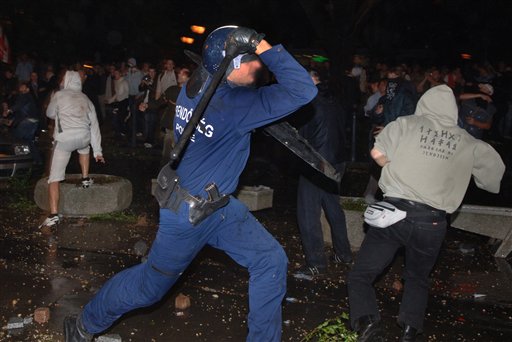
After more than a decade's worth of Western-prescribed economic reforms, people in Eastern Europe are saying they've had enough. On the day Hungary marked the 50th anniversary of the Soviet crushing of their uprising against the then Communist regime, thousands took to the streets. This was no reenactment. Hundreds were arrested, and a like number injured as police used rubber bullets, batons, and water canons to hold back a crowd trying to reach the parliament building in Budapest on October 24.

Hungary has been on edge for nearly two months since the country's prime minister was caught on tape, admitting he had cooked the books to paint a rosier economic picture. The lie helped win reelection in April for Prime Minister Ferenc Gyurcsany, a socialist in name, but uber capitalist in practice, who made millions, like other ethically-challenged go-getters in Eastern Europe, during the firesale privatization drives of the early 1990s.

Victory assured, Gyurcsany dropped a bomb, telling his compatriots the state of the economy wasn't that good after all, (in fact, the deficit was close to 11 percent, the highest in the EU), and belt-tightening reforms were needed to save the state's finances. Rosy became rotten.

More state cutbacks were to come, meaning gloomier prospects for many already reeling from reforms that have dismantled much of the old command economy system, but created little, outside of pockets of prosperity centered around the cities. Hungarian anger and disillusionment may be unchallenged in the region, but the underlining sentiments are not. Poland and Slovakia have booted out their "reformers", and in Bulgaria a relatively unknown journalist made it to a runoff vote for president, largely by campaigning against the reforms that have left most Bulgarians with lower purchasing power than before the 1989 fall of communism.

In Poland after years in the political wilderness, the Kaczynski twins came to power last year with pledges to weed out corruption and what they called "cliques" of former secret service agents, ex-communists and businessmen. They also preached a hodgepode of economic "populist" measures from i.e., boost social spending.

In Slovakia, a populist government has gained power by making a pact with two right-wing parties, one of whose leaders has opined that Hungarians living in Slovakia should be shipped back home across the Danube. Talk like that has fueled a feud between the two neighbors, marked by an attack by Slovak skinheads on a girl caught speaking Hungarian on her cell phone.

Saturday, March 18, 2006

Europe's Last Dictator Ready For Exit?


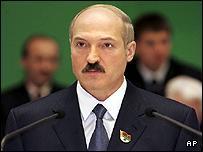
It's easy to make fun of Alexander Lukashenko. A former Kolhoz director, a brusque way of talking, a cheesy moustache and a slavish loyalty to Russian don, Vladimir Putin, make it easy comical picken's with the Belarus strongman. Now that Slobodan Milosevic has truly exited the European scene forever, the boilerplate applied to Alexander is that he is Europe's last of the dictators. It's not a hard case to argue. Belarus is caught in a time warp. It's like the Soviet Union never died. Hammers and sickles abound, the KGB is still kicking, usually the crap out of what opposition there is, and the shops are bereft of all the consumptible goodies found in the West. On the other hand, the economic indicators aren't all bad either. The World Bank, of all institutions, admits from 1996 to 2004 the economy grew by 6.6 percent and one fifth of the people moved out of poverty. And that other bastion of capitalism, the IMF, says real wages have nearly tripled. Ol' Luke has ruled Belarus for twelve years now, and one Sunday he'll likely get another five as the country holds a presidential election. Nevertheless, Lukashenko is a little nervous. He's seen old guard communist-vintage leaders fall in Georgia, Ukraine and Kyrgyzstan, all due in large part to p.r. savvy and internet-connected 'youth movements', all coached and funded by the West, namely Washington. Lukashenko has done his darndest to make sure they don't get into his country to corrupt his country's youth, not entirely successful however. Not one to mince words, Luke has vowed to "ring the necks" of anyone who thinks there'll be a revolution in Belarus a la Georgia and Ukraine. The KGB has warned it'll lock up protesters on charges of "terrorism" if they take to the streets after polls close on Sunday. On Saturday, anonymous leaflets in Minsk called for revolution and mobile phones received text messages either encouraging protests or warning people not to fall victim to bloodshed. The leading opposition candidate, Alexander Minkevich has called for his protesters to take to the streets on Sunday as soon as polls close, making it almost inevitable things will get ugly. Interestingly, the Czech "Week" news magazine reports many of Belarus's yuggens are likely to vote for Lukashenka. Many have joined the president's "Youth Union." The reason is simple. Membership opens doors to sought after university faculties. The rector of the country's top university put it simple to his students, telling them their stipends are two times higher than in Russia, and in the Baltic states they've practically disappeared. "See where so-called capitalism leads?"

Monday, February 20, 2006

The Devil Went Down To Georgia


The military monster, aka, the US of A, may be bogged down in Iraq and Afghanistan but that doesn't mean the war of terror doesn't go on. Unless you've been living under a rock, you know the US is gearing up for a 'military campaign' against Iran, who, wouldn't you know it, is on the cusp of acquiring those weapons of mass destruction, in fact, the deadliest of the lot, nuclear, and this has to be stopped. Anyway, this is not a report to debate or lampoon this scenario, alll pretty much a repeat of the Iraqi charade. This is to point to the latest developments in preparing for said attack-to-be. There's an interesting report in the Moscow News saying the U.S. is courting the Caucasus nation of Georgia to use it as a base to launch aerial raids on Iran’s several nuclear sites. The entire report is here.

As readers of the Informant know, Georgia is now led by one Mikhail Saakashvili, a Harvard-trained lawyer and certified Washington stooge. His Velvet Revolution was due to a healthy dose of US pr magic and internet savvy, following the template trailblazed in Serbia and then copied successfully in Ukraine and Kyrgyzstan, and not so successfully in Belarus. That’s not to say that his predecessor, Eduard Shevardnadze, was a saint, but once he put U.S. Caspian oil pipeline plans into doubt, he had to go. And go he did. Saakashvili has been one of the few European leaders to give unquestioned support to the Iraqi war-cum-quagmire. After President Bush was reelected, Georgia announced plans to increase its number of troops stationed in Iraq from 159 to 850. The Washington Times notes that given Georgia’s small population, this increase makes it one of the top contributors on a per capita basis


Saakashvili is now a shameless US backer and Russian basher. Out with the Russians and in with the Americans! During the Soviet era, Krtsanisi military base outside Tbilisi was home to the Red Army. Now it is US soldiers who are in charge and, according to the US Ambassador in Tbilisi Richard Miles, they are in Georgia to stay. In 2002 the Bush administration set up an 18-month, $65m program aimed at training and equipping Georgia's impoverished army.

According to Arms Trade Resource Center,for a country that is slightly smaller than South Carolina, with only 4.6 million citizens, Georgia receives a staggering amount of military support from the United States.

According to the center, in 1997 Georgia received its first FMF grant of $700,000. In 1998, Washington increased FMF more than 7 times over, granting $5.3 million in aid. Since those first years, Georgia has received a total of $107.7 million in FMF grants.[138] The Bush administration requested an additional $12 million in the 2006 budget.

Both Secretary of State Colin Powell and Secretary of Defense Donald Rumsfeld visited Georgia in 2004, pledging continued U.S. support to the country.

Georgia, an aggressive force in a number of border disputes and a state with a well-documented history of human rights violations, does not seem like an ideal candidate for U.S. military aid. Human Rights Watch says the country is, "one of the most corrupt in the world, is desperately short of money, and has a record of persistent and widespread human rights abuses."

The State Department agrees, finding in its most recent Human Rights Report that "nongovernmental organizations blamed two deaths in custody on physical abuse. NGOs reported that police brutality continued, and in certain areas increased. Law enforcement officers continued to torture, beat, and otherwise abuse detainees."

Despite his sycophancy, Saakashvili seems a little weak in the knees about getting involved in the next US attack. Apparently he does not share the unabashed enthusiasm of the Busheviks and feels there could be reprecussions for his small Caucasus nation should it play any role in a U.S. attack on Iran. Stay tuned...

Monday, February 13, 2006

Islam And Europe


Every two-bit pundit has rubbed his chin on this one, so why not yours truly. I never thought I'd see the day fuzzy, progressive countries like Denmark and Norway would be targeted by angry mobs. But the TV images don't lie. Pissed off crowds have set on their embassies in Beirut and Damascus and demos have erupted everywhere else across the Muslim world and in major European cities as well, Paris, London, and Berlin. All over images like the one pictured here, in this cartoon chaos. It would be easy to jump on the bandwagon, expressing outrage over how many of these protests have turned really ugly, with the torching of embassies in Syria and Lebanon, in particular. The violence is a tactical no-no, turning away anyone maybe willing to listen to their argument that the Danish paper that started this mess exhibited religious intolerance, fanned the flames of hatred, ecetera... all by the way legitimate points, especially, as the Guardian has pointed out, the same obscure Danish rag balked at printing some risque Jesus drawings out of fear of offending Christians. It's a shame, the focus now has shifted to the violent response, and not to the cause of it, at least in the vaunted "West," just further ripping the gulf further apart between what are, I have to admit, two very different worlds, but I won't get sucked into the "Clash of Culture" trap. Here in Europe, there's been a backlash against "multiculturalism," sparked I guess, if you can peg such things, to the killing in Holland of director Theo Van Gogh. A Muslim, Mohammed Bouyeri, who is now serving a life sentence, shot and stabbed Van Gogh as he cycled through Amsterdam in 2004. He claimed he acted out of religious conviction. Now that happened in hip Holland, best known for its red light districts and hash brownies in Amsterdam, all underscoring its liberal image. The Van Gogh murder prompted lots of Dutch to question their liberal live-and-let-be policies to immigrants under which there wasn't even a requirement to learn the Dutch language. That debate also comes with much of Holland's generous welfare safety net being chipped away at by its right-wing government. When people are either out of work or fear losing their jobs, they tend to take a less charitable view of those worse off. Then this November France was racked by the worst urban violence since the student-worker riots of 1968. In three weeks of rioting, about 9,000 vehicles were torched, hundreds of schools and public buildings attacked, and more than 3,000 people arrested. Many of those doing the damage were offspring of emigrants from North Africa and the Middle East, a remnant of France's colonial past. Some progressives pointed to France's failure to integrate them, highlighting that country's shameful racism. But the unrest furthered the divide between blacks and whites, Christians and Muslims across the continent. Television images of youths setting fire to cars, trash bins, shops, buses, did little to soften up French or other European peoples to the plight of the migrant poor. In Denmark, the government of Prime Minister Anders Fogh Rasmussen has courted the right in his country, creating a less tolerant, anti-Muslim atmosphere there. The Europeans aren't the only ones seeing objectionable images on their television screens. Muslims routinely see or hear or read stories of Muslims being tortured or killed in Iraq and Afghanistan where the Americans have reputation for shooting first and asking questions later. Lest we forget, Abu Ghraid and Guantanamo and those images of torture. In the latest affront, a British tabloid, the News of the World, got their hands on a very nasty video, depicting what looks like British soldiers having a good ol' time beaten up Iraqi boys. Elsewhere, Palestinians are still routinely humiliated by the Israelis without much objection from Europe, let alone the U.S. These injustices goes largely unnoticed in the West, not in the Muslim world. While the anger is real, that doesn't mean others aren't exploiting it for their own purposes. It's no coincidence that Iran and Syria-- currently on the U.S. blacklist and possibly on deck for military action -- have witnessed some of the more violent protests. Stirring up anti-Western sentiment can give them a little breathing room and shore up their own sagging support. Sadly, when more reasoned and calm voices are needed, it is the shrill that are being heard right now.

Saturday, February 11, 2006

Strange Days in Poland


Imagine a government led by Pat Robertson. Scary, right? Well, Poland may be the closest thing to a "700 Club" fantasy on the face of the earth. Take the governing "Law and Justice" party, which backs conservative favorites, like "traditional values", and an agenda that is full of 'antis' like gay, immigrant and EU. Oddly, the party backs a generous social welfare network, not something Pat and his crew would likely take a shining to although in synch with other populist parties. Now, Law and Justice won parliamentary elections back in September, but they didn't win enough seats to form a government. So, what do they do? Turn to even smaller, and more rightwing parties to govern. It's getting pretty scary in Poland.

How bad is it in ultra-conservative Catholic Poland? Just ask Alicja Tysiac. She is pretty close to blind and wears really think glasses to see. Last year, three eye specialists warned her she risked going completely blind if she took her third pregnancy to term. Slightly freaked, Tysiac sought frantically for a doctor to give her an okay to abort the pregnancy. Legal under communism, abortion is now illegal in Poland, unless the health of the mother or child is at risk. Tysiac did finally find one doctor who did agree having the child would threaten her eyesight. However, when she went to a Warsaw hospital, the staff there didn't see it that way(pardon the weak pun), and refused to do it. After the birth, Tysiac's vision did deteriorate. Now, the single-parent Tysiac sits at home in Warsaw, next to blind and living off a meager monthly welfare check. It won't bring back her vision, but Tysiac has taken her case to the European Court of Human Rights.

Robertson wouldn't be the only American-that-mattered to be all a titter with Poland. Our Prez, Mr. Bush has called Poland America's best European ally outside of Britain, and its poodle quizzling, Tony Blair. Chalk that up in part to a strong ethnic Polish lobby in the U.S., (Chicago has the highest concentration of Poles outside of Warsaw) whose feverish anti-Communist has ingrained a strong pro-US stance. During the Iraqi quagmire, Poland has stood at attention saluting commandante Bush. Remember the "Coalition of the Willing" El Salvador ecetera in Iraq? Well Poland is still there, even though their 1,500 troops were set to come home in January. (While most Poles are Yankie-friendly, like all Europeans most do not support the U.S.-led war in Iraq.)But the Law and Justice Party said nope, and now the Poles will remain in southern Iraq. And those furtive CIA prisons in Eastern Europe? Yep, Poland is said to house at least one of them along with fellow top suspect Romania. It's not all that eye-brow-raising given that Poland's Defense Minister Radek Sikorski is a committed neo-conservative who worked as a resident fellow at the American Enterprise Institute (AEI), where he toiled alongside such neo-con stalwarts Michael Ledeen and Richard Perle.

According to Insider Magazine, Sikorski has a spooks past working for the CIA. Polish intelligence sources report that Sikorski became a U.S. intelligence asset during the Reagan Cold War years. Sikorski was a Solidarity leader in the 1970s. He was visiting Britain in 1981 when martial law was declared in Poland. In 1984 Sikorski became a British citizen.

Sikorski operated under the cover of a journalist in Soviet-occupied Afghanistan during the mid 1980s and in Angola in the late 1980s where he liaised with pro-U.S. UNITA guerrillas backed by apartheid South Africa and noted GOP activists, including recently convicted Jack Abramoff as well as Karl Rove friend and adviser Grover Norquist.

Some in Europe, including ol' French President Jacques Chirac, look warily at Poland, fearing Warsaw is a fifth column doing the bidding of Washington at the expense of efforts to build an EU superstate, complete with a robust foreign policy outside of Washington's control.

Sunday, February 05, 2006

NATO, What's It For?


Unbeknownst to most of you, assorted generals and majors from that military dinosaur NATO got together in Munich recently for their yearly powwow to chit chat on "security issues." NATO is still something of a lost child after losing its play partner the Soviet Union years ago. Since then, NATO has been in search of a new "mission." Bombing Yugoslavia in 1999 to "save" ethnic Albanians in Kosovo was part of that effort. It was the first time the military club had used its weapons for real not to repel an invasion -- as spelled out in its charter to justify action -- but to attack a sovereign nation that hadn't threatened it. Anyway, that mission didn't solve all the problems of NATO which now stands at 26 members having taken in lots of former enemy Warsaw Pact states. Anyway to the meeting. Angela Merkel, Germany's first female chancellor, has been in sycophant overdrive taking every available opportunity to brown nose the Busheviks in Washington, who felt snubbed by her predecessor, Gerhard Schroeder, whose anti-Iraq war rhetoric peeved off Bush and crew. (However, as the Informant and other top news sites have pointed out, it seems the German intelligence services were providing the Yanks with some furtive bombing target data during the 2003 U.S.-led invasion of Iraq.) So what did Angela have to say? Lots. She opined NATO "should be the first place to discuss international conflicts." I guess Angela forgot about another international organization with a slighly larger membership -- 190 countries or so --call the United Nations, set up for just the purpose Angela would like handed over to the more selective NATO club. Merkel called for NATO to engage in "broader operations" and take on "a primary role in the world." I can just see Bush and his bunch standing off by the side, rubbing their hands, saying "excellent, Angela, excellent."

Not to be outdone in the butt-licking department, German Defense Minister Franz Josef Jung also saw lots of work ahead for NATO. "Terrorism, the proliferation of weapons of mass destruction, failing states -- these are the scourges of our times," Jung told the conference. "The old NATO as a purely defensive alliance is history," he added. In hindsight, what do you expect a military man to say?

US Defense Secretary Donald Rumsfeld thanked Merkel for her "thoughtful and important remarks on NATO." But Rummy lectured the Europeans on their shyness not to splurge on military spending like in the ol' US. "Insufficient" military spending, as Rummy put it, is holding back NATO's "potential."

The United States was spending 3.7 percent of its GDP on defense but other NATO members were spending far less, he said.

Leave it to the French, however, to be difficult. French Defense Minister Michele Alliot-Marie took a more skeptical view on NATO's role and stressed the importance of the European Union's growing security capability, reflecting widespread concerns in France that a stronger NATO would mean a weaker EU.

Hey, wait a minute, how can NATO and the US keep an eye and control over the Europeans, if the EU is stronger? Bad idea, Michele, bad. You're getting a little too uppity.

NATO Secretary General Jaap de Hoop Scheffer, however, supported "pragmatic" cooperation between NATO and the European Union and sought to calm French fears. He did say something very, very interesting. De Hoop Scheffer, (phew, that's a name) said NATO could "protect energy supply lines" from "terrorists." Protecting energy sources with military might? Sounds like the stuff those conspiracy nuts have been saying all along that motivates the U.S. in the former Soviet Union, specifically in the Caucasus and the Caspian Sea region, where oil and pipelines abound.

Just try, try, for a moment to look at this from Russian President Vladimir Putin's position. His country's erstwhile enemy is now talking about 'protecting' energy resources that lie within the old Soviet empire and not too far from presentday Russia. Might make him antsy, no?